NLRP3 Mouse Monoclonal antibody
3H1A7, Angiotensin/vasopressin receptor AII/AVP-like, C1orf7, CIAS1, Cold-induced autoinflammatory syndrome 1 protein
-
货号:
AM20203 -
规格:
- 20ul
- 50ul
- 100ul
- 150ul
-
价格:
¥0.00
3H1A7, Angiotensin/vasopressin receptor AII/AVP-like, C1orf7, CIAS1, Cold-induced autoinflammatory syndrome 1 protein
| 产品类型 | Monoclonal |
| 基因名称 | NLR family, pyrin domain containing 3 |
| 经测试应用 | WB, IHC, IF/ICC |
| 宿主 | Mouse |
| 种属反应性 | Human |
| 免疫原 | A synthesized peptide derived from human NLRP3 |
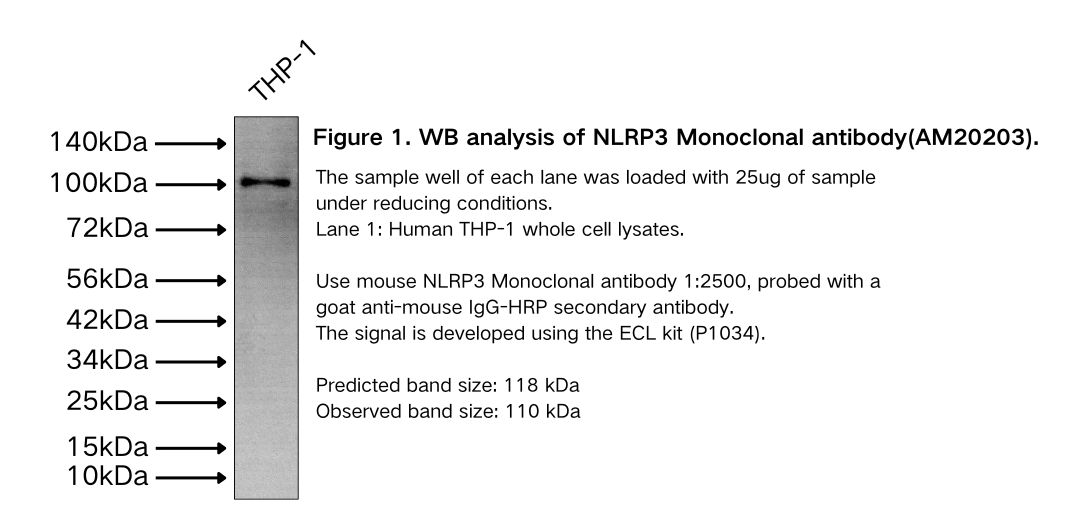
| 理论分子量 | 118 kDa |
| 实际分子量 | 110 kDa |
| Gene ID(NCBI) | 114548 |
| GeneBank Accession Number | NM_001079821 |
| UNIPROT | Q96P20 |
| 形式 | Liquid |
| 保存条件 | Store at -20℃. Stable for one year after shipment. Aliquoting is unnecessary for -20℃ storage. |
| 推荐稀释比例 | 1:1000-1:5000 |
| 背景信息 | This gene encodes a pyrin-like protein containing a pyrin domain, a nucleotide-binding site (NBS) domain, and a leucine-rich repeat (LRR) motif. This protein interacts with the apoptosis-associated speck-like protein PYCARD/ASC, which contains a caspase recruitment domain, and is a member of the NLRP3 inflammasome complex. This complex functions as an upstream activator of NF-kappaB signaling, and it plays a role in the regulation of inflammation, the immune response, and apoptosis. The SARS-CoV 3a protein, a transmembrane pore-forming viroporin, has been shown to activate the NLRP3 inflammasome via the formation of ion channels in macrophages. Mutations in this gene are associated with familial cold autoinflammatory syndrome (FCAS), Muckle-Wells syndrome (MWS), chronic infantile neurological cutaneous and articular (CINCA) syndrome, neonatal-onset multisystem inflammatory disease (NOMID), keratoendotheliitis fugax hereditarian, and deafness, autosomal dominant 34, with or without inflammation. Multiple alternatively spliced transcript variants encoding distinct isoforms have been identified for this gene. Alternative 5' UTR structures are suggested by available data; however, insufficient evidence is available to determine if all of the represented 5' UTR splice patterns are biologically valid. |

邮箱:info@TianyaBio.com
电话:020-3107 8154
地址:广州市番禺区兴业大道东路1078号2-50

微信公众号

微信客服