Ribociclib 瑞博西尼; LEE011
Ribociclib (LEE011) 是一种高度特异性的 CDK4/6 抑制剂,IC50 值分别为 10 nM 和 39 nM,对 cyclin B/CDK1 复合体的活性低于其 1000 倍。
-
货号:
TK0553 -
规格:
- 1mg
- 2mg
- 5mg
-
价格:
¥0.00
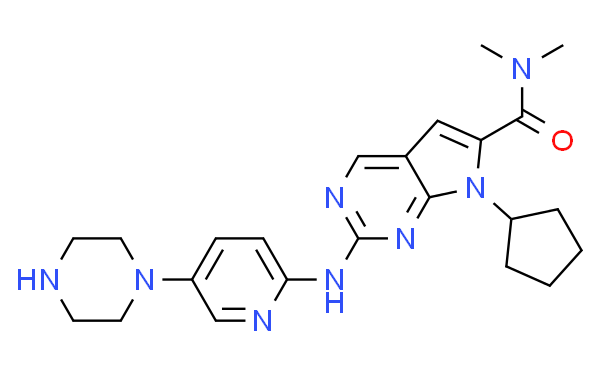
Ribociclib (LEE011) 是一种高度特异性的 CDK4/6 抑制剂,IC50 值分别为 10 nM 和 39 nM,对 cyclin B/CDK1 复合体的活性低于其 1000 倍。
| CAS No. | 1211441-98-3 |
| 生物活性 | Ribociclib (LEE01) is a highly specific CDK4/6 inhibitor with IC50 values of 10 nM and 39 nM, respectively, and is over 1,000-fold less potent against the cyclin B/CDK1 complex. |
| 分子式 | C23H30N8O |
| 分子量 | 434.54 |
| 运输条件 | Room temperature in continental US; may vary elsewhere. |
| 储存条件 | Powder -20°C 3 years |
| 溶解性数据 | DMSO : 5.4 mg/mL (12.43 mM; Need ultrasonic) |
| 体内研究 | CB17 immunodeficient mice bearing BE2C, NB-1643 (MYCN amplified, sensitive in vitro), or EBC1 (non-amplified, resistant in vitro) xenografts are treated once daily for 21 days with Ribociclib (LEE011; 200 mg/kg) or with a vehicle control. This dosing strategy is well tolerated, as no weight loss or other signs of toxicity are observed in any of the xenograft models. Tumor growth is significantly delayed throughout the 21 days of treatment in mice harboring the BE2C or 1643 xenografts (both, p<0.0001), although growth resumed post-treatment. |
| 体外研究 | Treating a panel of 17 neuroblastoma cell lines with Ribociclib (LEE011) across a four-log dose range (10 to 10,000 nM). Treatment with Ribociclib significantly inhibits substrate adherent growth relative to the control in 12 of the 17 neuroblastoma cell lines examined (mean IC50=306±68 nM, considering sensitive lines only, where sensitivity is defined as an IC50 of less than 1 μM. Ribociclib treatment of two neuroblastoma cell lines (BE2C and IMR5) with demonstrated sensitivity to CDK4/6 inhibition results in a dose-dependent accumulation of cells in the G0/G1 phase of the cell cycle. This G0/G1 arrest becomes significant at Ribociclib concentrations of 100 nM (p=0.007) and 250 nM (p=0.01), respectively. |
| 文献 | •Mol Cell. 2017 Oct 19;68(2):336-349.e6. •Sci Transl Med. 2018 Jul 18;10(450). pii: eaaq1093. •Nat Commun. 2021 Sep 10;12(1):5386. •Nat Commun. 2021 Aug 25;12(1):5112. •Nat Commun. 2019 Jun 28;10(1):2860. •Cancer Res. 2019 Oct 15;79(20):5245-5259. •Clin Cancer Res. 2015 Nov 1;21(21):4947-59. •Cell Rep. 2020 Aug 4;32(5):107995. •Cell Rep. 2017 Oct 31;21(5):1386-1398. •Eur J Cancer. 2018 Oct;102:10-22. •Cell Death Dis. 2020 Sep 15;11(9):754. •JCI Insight. 2021 Dec 21;e154402. •NPJ Precis Oncol. 2021 Mar 19;5(1):20. •Cell Chem Biol. 2019 Aug 15;26(8):1067-1080.e8. •Cell Chem Biol. 2018 Feb 15;25(2):135-142.e5. •Cancers. 2020 Jun 16;12(6):1596. •Mol Oncol. 2017 Aug;11(8):1035-1049. •Int J Biol Sci. 2019 Jan 1;15(3):522-532. •Biomed Pharmacother. 2019 Feb 18;112:108602. •Breast Cancer Res. 2019 Dec 26;21(1):150. •Mol Cancer Ther. 2018 May;17(5):897-907. •J Infect Dis. 2018 Nov 22;218(suppl_5):S365-S387. •Sci Rep. 2021 Mar 8;11(1):5374. •J Pharmaceut Biomed. 2021, 113933. •Biomed Res Int. 2020 Jun 11;2020:9525207. •RSC Adv. 2020, 10(38):22668-22683. •Artif Cells Nanomed Biotechnol. 2019 Dec;47(1):4001-4011. •J Chromatogr B. 2020 Jun 15;1147:122142. •Fundam Clin Pharmacol. 2021 Feb 1. •Eur J Drug Metab Pharmacokinet. 2021 Jul 18;1-11. •Biomed Chromatogr. 2020 Mar;34(3):e4783. •Nature Cancer. 2021 Apr;2(4):429-443. •Department of Biochemistry. 2020 Oct. •Harvard Medical School LINCS LIBRARY |
| 纯度及产品资料 | 98% |

邮箱:info@TianyaBio.com
电话:020-3107 8154
地址:广州市番禺区兴业大道东路1078号2-50
微信公众号

微信客服