H-89 dihydrochloride
H-89 dihydrochloride 是一种有效、选择性的 cAMP 依赖性蛋白激酶A (PKA) 抑制剂,IC50 值为 48 nM。也可轻微抑制 PKG,PKC,酪蛋白激酶活性。
-
货号:
TK0502 -
规格:
- 5mg
- 10mg
- 50mg
- 100mg
-
价格:
¥0.00
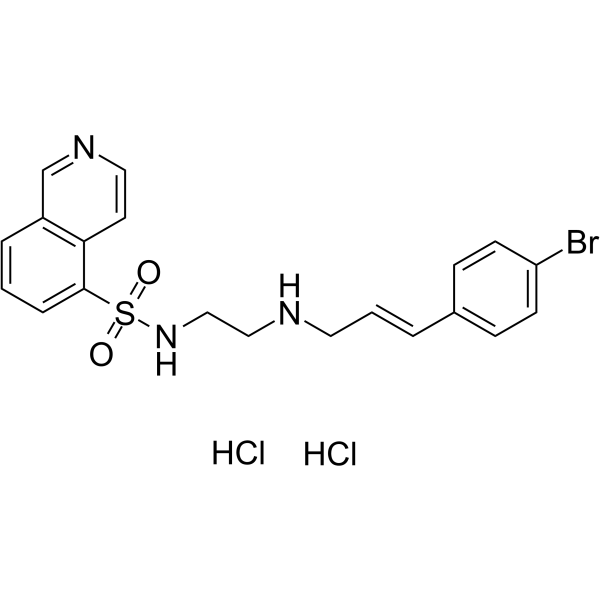
H-89 dihydrochloride 是一种有效、选择性的 cAMP 依赖性蛋白激酶A (PKA) 抑制剂,IC50 值为 48 nM。也可轻微抑制 PKG,PKC,酪蛋白激酶活性。
| CAS No. | 130964-39-5 |
| 生物活性 | H-89 dihydrochloride is a potent and selective inhibitor of protein kinase A (PKA) with an IC50 of 48 nM and has weak inhibition on PKG, PKC, Casein Kinase. |
| 分子式 | C20H24BrCl2N3O3S |
| 分子量 | 519.28 |
| 运输条件 | Room temperature in continental US; may vary elsewhere. |
| 储存条件 | Powder -20°C 3 years |
| 溶解性数据 | DMSO : 100 mg/mL (192.57 mM; Need ultrasonic) H2O : 5 mg/mL (9.63 mM; ultrasonic and warming and heat to 80°C) |
| 体内研究 | H-89 (0.2 mg/100g, i.p.) significantly increases seizure latency and threshold in PTZ-treated animals. H-89 (0.05, 0.2 mg/100 g, i.p.) prevents the epileptogenic activity of bucladesine (300 nM) with significant increase of seizure latency and seizure threshold. |
| 体外研究 | H-89 inhibits protein kinase A, in competitive fashion against ATP. H-89 causes a dose-dependent inhibition of the forskolin-induced protein phosphorylation, with no decrease in intracellular cyclic AMP levels in PC12D cells. H-89 significantly inhibits the forskolin-induced neurite outgrowth from PC12D cells. H-89 (30 μM) inhibits significantly cAMP-dependent histone IIb phosphorylation activity in PC12D cell lysates. H-89 (1-2 μM) significantly slows the repriming rate in rat skinned fibres, most likely due to it deleteriously affecting the T-system potential. H-89 (10-100 μM) inhibits net Ca uptake by the SR and affectes the Ca-sensitivity of the contractile apparatus in rat skinned fibres. |
| 文献 | •Cell Metab. 2021 Sep 8;S1550-4131(21)00375-2. •Cell Metab. 2021 Mar 2;33(3):565-580.e7. •Adv Sci (Weinh). 2021 Oct 31;e2100808. •Prog Neurobiol. 2021 Mar 22;102041. •Theranostics. 2021 Mar 24;11(12):5650-5674. •Theranostics. 2021 Jan 1;11(6):2612-2633. •Clin Transl Med. 2021 Jan 1. •J Exp Clin Cancer Res. 2021 Apr 8;40(1):122. •Cell Rep. 2021 Sep 21;36(12):109726. •Aging Cell. 2018 Jun;17(3):e12754. •Sci Signal. 2020 Nov 24;13(659):eaax0273. •Genes Dis. 2020 Nov 21;8(6):867-881. •J Periodontol. 2019 Sep;90(9):1002-1013. •Stem Cell Res Ther. 2020 May 19;11(1):182. •Stem Cell Res Ther. 2020 Jan 3;11(1):2. •Ecotoxicol Environ Saf. 2021 Feb 25;214:112005. •Front Oncol. 2021 Oct 6;11:738300. •J Neurosci. 2016 Oct 12;36(41):10560-10573. •Int J Mol Sci. 2018 Oct 7;19(10). pii: E3053. •J Bone Miner Res. 2021 May 5. •Front Pharmacol. 2018 Apr 12;9:362. •Cancer Cell Int. 2019 Sep 23;19:241. •Nutrients. 2020 Jan 26;12(2):329. •Cell Commun Signal. 2021 Oct 11;19(1):103. •Aging (Albany NY). 2020 Jun 9;12(11):10951-10968. •Aging (Albany NY). 2018 Jul 24;10(7):1722-1744. •iScience. 2021, 102820. •J Cell Mol Med. 2020 Apr;24(8):4736-4747. •FASEB J. 2020 Oct;34(10):13376-13395. •J Biol Chem. 2021 Apr 8;100644. •Psychoneuroendocrinology. 2020 Jul;117:104680. •Front Physiol. 2021 Oct 28;12:770430. •Bone. 2020 Jun;135:115326. •Mol Brain. 2021 Jul 19;14(1):116. •Arch Biochem Biophys. 2020 Jul 15;687:108375. •Exp Cell Res. 2021 Feb 15;399(2):112482. •Biol Trace Elem Res. 2020 Sep 14. •Vet Microbiol. 2021, 109061. •Infect Immun. 2018 Dec 19;87(1). pii: e00508-1 •Neurogastroenterol Motil. 2020 Oct;32(10):1514-1528. •Evid-Based Compl Alt. Dec 12. •J Bone Miner Metab. 2021 Apr 8. •Aquac Res. 2020;00:1-10. •J Int Med Res. 2021 Mar;49(3):300060521999527. •Research Square Preprint. 2020 Oct. •Royal Society of Chemistry. 2020, 11, 1132-1139. •IJMPNP. 2019,5(1): 8-15. •Harvard Medical School LINCS LIBRARY |
| 纯度及产品资料 | 98% |

邮箱:info@TianyaBio.com
电话:020-3107 8154
地址:广州市番禺区兴业大道东路1078号2-50

微信公众号

微信客服