THZ1
THZ1 是有效,选择性的共价 CDK7 抑制剂,IC50 为 3.2 nM。THZ1 还抑制相关的激酶 CDK12 和 CDK13,并下调 MYC 表达。
-
货号:
TK0264 -
规格:
- 1mg
- 5mg
-
价格:
¥0.00
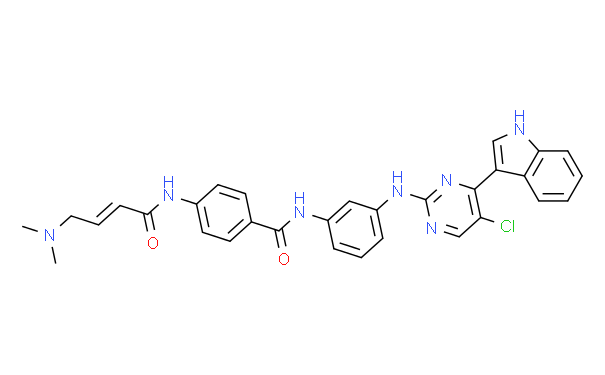
THZ1 是有效,选择性的共价 CDK7 抑制剂,IC50 为 3.2 nM。THZ1 还抑制相关的激酶 CDK12 和 CDK13,并下调 MYC 表达。
| CAS No. | 1604810-83-4 |
| 生物活性 | THZ1 is a selective and potent covalent CDK7 inhibitor with an IC50 of 3.2 nM. THZ1 also inhibits the closely related kinases CDK12 and CDK13 and downregulates MYC expression. |
| 分子式 | C31H28N7O2Cl |
| 分子量 | 566.05 |
| 运输条件 | Room temperature in continental US; may vary elsewhere. |
| 储存条件 | Powder -20°C 3 years |
| 溶解性数据 | DMSO : 100 mg/mL (176.66 mM; Need ultrasonic) Ethanol : < 1 mg/mL (insoluble) |
| 体内研究 | THZ1 (10 mg/kg) demonstrates potent killing of primary chronic lymphocytic leukemia (CLL) cells and anti-proliferative activity against primary TALL cells and in vivo against a human T-ALL xenograft. THZ1 (10 mg/kg, i.v.) inhibits tumor growth in a mouse model of human MYCN-amplified NB and shows no toxicity. THZ1 (10 mg/kg, i.p.) completely suppresses oesophageal squamous cell carcinoma tumour growth in vivo without loss of body weight or other common toxic effects. |
| 体外研究 | THZ1 inhibits Jurkat cell and Loucy cell with IC50 of 50 nM, and 0.55 nM, respectively. THZ1 (9, 27, 83, 250, 750, and 2500 nM) inhibits CDK12 but at higher concentrations compared to CDK7. THZ1 (1 μM) irreversibly inhibits RNAPII CTD and CAK phosphorylation. THZ1 (2.5 µM) irreversibly inhibits RNAPII CTD phosphorylation by covalently targeting a unique cysteine located outside the kinase domain of CDK7 in Hela S3 cells. THZ1 (250 nM) causes decreased cellular proliferation and an increase in apoptotic index with concomitant reduction in anti-apoptotic proteins, most notably MCL-1 and XIAP in T-ALL cell lines. All genotypically-distinct human (hSCLC) cell lines exhibit high sensitivity to THZ1, with an IC50 in the range of 5-20 nM. |
| 文献 | •Nat Med. 2019 Feb;25(2):292-300. •Science. 2021 Apr 30;372(6541):eaba8490. •Cell. 2018 Sep 20;175(1):171-185.e25. •Cell. 2017 Sep 7;170(6):1209-1223.e20. •Cancer Discov. 2019 Nov;9(11):1538-1555. •Nat Cell Biol. 2020 Oct;22(10):1187-1196. •Mol Cell. 2019 May 16;74(4):674-687.e11. •Hepatology. 2019 Jun;69(6):2502-2517. •Autophagy. 2021 Jun;17(6):1426-1447. •Nat Commun. 2019 Jul 25;10(1):3319. •Nat Commun. 2018 Nov 19;9(1):4866. •Nat Commun. 2018 Aug 23;9(1):3392. •Sci Adv. 2020 Jul 17;6(29):eaba1593. •Cancer Res. 2021 Jun 1;81(11):3105-3120. •Genes Dev. 2020 Jan 1;34(1-2):53-71. •Proc Natl Acad Sci U S A. 2019 Jun 25;116(26):12986-12995. •J Exp Clin Cancer Res. 2021 Apr 26;40(1):141. •Clin Cancer Res. 2019 Oct 15;25(20):6195-6205. •Oncogene. 2019 May;38(20):3932-3945. •Cancer Immunol Res. 2021 Apr 19. •Cancer Lett. 2021 Mar 16;S0304-3835(21)00117-8. •J Invest Dermatol. 2021 May 15;S0022-202X(21)01232-X. •Cell Death Dis. 2021 Aug 3;12(8):763. •Cell Death Dis. 2021 Mar 3;12(3):229. •Cell Death Dis. 2020 Sep 15;11(9):754. •Cell Death Dis. 2019 Aug 9;10(8):602. •Oncogenesis. 2020 May 12;9(5):47. •Oncogenesis. 2017 May 15;6(5):e336. •Cell Oncol. 2021 Apr 27. •Cells. 2021 May 12;10(5):1182. •Cells. 2020 Mar 6;9(3):638. •Cells. 2020 Mar 4;9(3):621. •Cells. 2019 Oct 6;8(10):1208. •Int J Biol Sci. 2019 Jun 10;15(8):1733-1742. •Mol Cancer Ther. 2017 Sep;16(9):1739-1750. •Front Oncol. 2021 May 24;11:664848. •Front Oncol. 2021 Apr 6;11:663360. •Acta Pharmacol Sin. 2019 Jun;40(6):814-822. •Front Mol Biosci. 2021 Aug 19;8:697457. •Biochim Biophys Acta Mol Cell Res. 2019 Jun;1866(6):978-991. •Onco Targets Ther. 2019 Mar 22;12:2137-2147. •IUBMB Life. 2021 Oct 30. •J Mol Neurosci. 2021 Aug 31. •Research Square Preprint. 2022 Jan. •bioRxiv. June 18, 2021. •bioRxiv. 2019 Oct. •Oncotarget. 2017 Apr 18;8(16):27353-27363. •TUMOR, 2017, 37(11): 1119-1127. •Harvard Medical School LINCS LIBRARY |
| 纯度及产品资料 | 98% |

邮箱:info@TianyaBio.com
电话:020-3107 8154
地址:广州市番禺区兴业大道东路1078号2-50

微信公众号

微信客服