Bleomycin sulfate 硫酸博来霉素
Bleomycin sulfate 是一种 DNA 损伤剂,抑制 DNA 合成。Bleomycin sulfate 是一种抗肿瘤抗生素 (antibiotic)。
-
货号:
TK0240 -
规格:
- 1mg
- 2mg
- 5mg
- 10mg
-
价格:
¥0.00
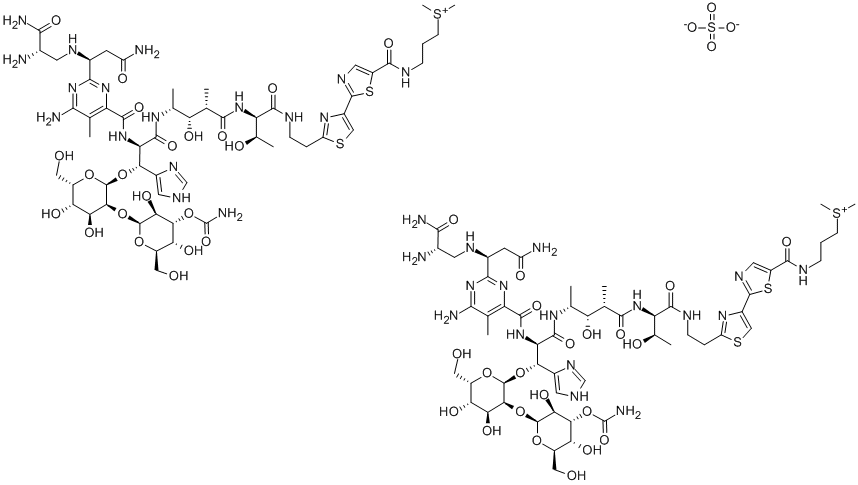
Bleomycin sulfate 是一种 DNA 损伤剂,抑制 DNA 合成。Bleomycin sulfate 是一种抗肿瘤抗生素 (antibiotic)。
| CAS No. | 9041-93-4 |
| 生物活性 | Bleomycin sulfate is a DNA synthesis inhibitor. Bleomycin hydrochloride is a DNA damaging agent. Bleomycin sulfate is an antitumor antibiotic. |
| 分子式 | C55H85N17O25S4 |
| 分子量 | 1512.62 |
| 运输条件 | Room temperature in continental US; may vary elsewhere. |
| 储存条件 | Powder -20°C 3 years |
| 溶解性数据 | H2O : 255 mg/mL (168.58 mM; Need ultrasonic and warming) DMSO : 41.67 mg/mL (Need ultrasonic) |
| 体内研究 | Bleomycin sulfate treatment (3.5-4.0 mg/kg; intra-tracheal) on day 0, body weights decreases by day 4 then increases by Day 7 through the end of the study. Bleomycin sulfate (3.5-4.0 mg/kg; intra-tracheal) produces a statistically significant increase in lung hydroxyproline levels, and also increases right caudal lung lobe mass. Bleomycin sulfate (intratracheal instillation; 5.0 mg/kg/day) induces pulmonary fibrosis in eighty 8-week-old male BALB/c mice with weight about 20-30 g. Bleomycin induces the expression levels of α-SMA and collagen I. Bleomycin sulfate (intratracheally; 2.5 mg/kg; 1.25 mg/ml, approximately 50 µl per mouse) induces pulmonary fibrosis in male C57BL/6 mice (8 weeks old, average weight approximately 24.5 g). |
| 体外研究 | Bleomycin (BLM) sulfate is chosen as the best-studied micronucleus (MN) inducers in human lymphocytes with different mechanisms of genotoxicity. The most frequent Bleomycin-induced DNA lesions are single and double strand breaks and single apuinic/apyrimidinic sites. At the same time Bleomycin is true radiomimetic compound, resembling almost completely the genetic effect of ionizing radiation. The IC50 value of Bleomycin sulfate for UT-SCC-19A cell line is 4.0±1.3 nM. UT-SCC-12A and UT-SCC-12B are both more resistant to Bleomycin (BLM); IC50 values are 14.2±2.8 nM and 13.0±1.1 nM, respectively. Bleomycin sulfate (50, 100 μM; for 24, 48 h) induce pulmonary fibrosis in RLE-6TN cell (50 μM) and A549 cell (100 μM). |
| 文献 | •Nat Metab. 2021 Dec 6. •Small. 2021 Oct 8;e2103919. •Redox Biol. 2021 Jul 26;46:102082. •J Cell Biol. 2021 Feb 1;220(2):e201911025. •ACS Appl Mater Interfaces. 2019 Jan 16;11(2):1942-1950. •Cell Death Dis. 2020 Nov 13;11(11):978. •Cell Death Dis. 2020 Nov 12;11(11):976. •Cell Death Dis. 2020 Jun 15;11(6):464. •OncoImmunology. 2020 Sep 22;9(1):1824631. •Am J Respir Cell Mol Biol. 2021 Oct 28. •Am J Respir Cell Mol Biol. 2021 Apr 16. •Am J Respir Cell Mol Biol. 2021 Mar 24. •Am J Respir Cell Mol Biol. 2019 Apr;60(4):478-487. •Cells. 2021, 10(2), 202. •Oxid Med Cell Longev. 01 Nov 2021. •Oxid Med Cell Longev. 30 Jun 2021. •Biomed Pharmacother. 2021, 111500. •Biochem Pharmacol. 2020 Apr;174:113846. •Respir Res. 2020 Nov 2;21(1):290. •Respir Res. 2020 Feb 19;21(1):58. •Life Sci. 2021 Jan 1;264:118664. •Cell Signal. 2021 Aug 4;110106. •Ther Adv Chronic Dis. 2020 Jul 30;11:2040622320940185. •Biochem Biophys Res Commun. 2020 Jun 30;527(3):662-667. •Immunopharmacol Immunotoxicol. 2020 Oct;42(5):436-444. •Mutat Res Genet Toxicol Environ Mutagen. 2016 Sep 15;808:27-37. •Chinese Journal of Plastic and Reconstructive Surgery. 23 December 2021. •Fundamental Research. 23 December 2021. •Patent. US20190282565A1. •Patent. US20190255042A1. |
| 纯度及产品资料 | 98% |

邮箱:info@TianyaBio.com
电话:020-3107 8154
地址:广州市番禺区兴业大道东路1078号2-50

微信公众号

微信客服