咨询热线:

020-3107 8154

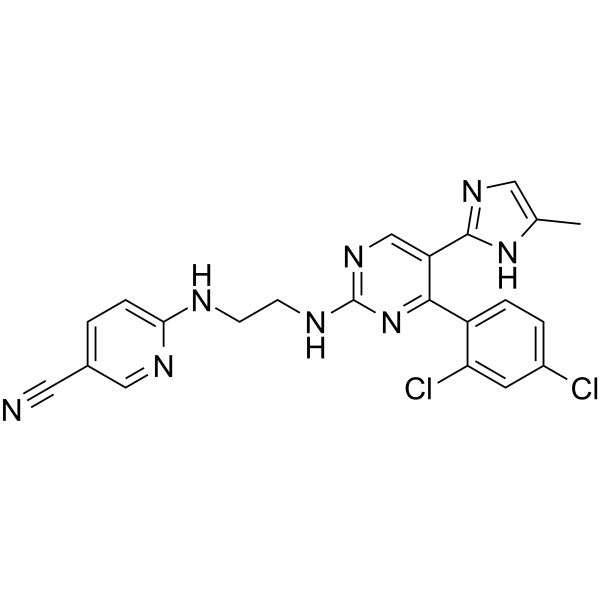
Laduviglusib CHIR-99021; CT99021

Laduviglusib (CHIR-99021) 是一种有效的选择性 GSK-3α/β 抑制剂,IC50 为 10 nM 和 6.7 nM。Laduviglusib 对 GSK-3 的选择性比 CDC2,ERK2 和其他蛋白激酶高 500 倍以上。Laduviglusib 还是一种有效的 Wnt/β-catenin 信号通路激活剂。CHIR-99021 可增强小鼠和人类胚胎干细胞的自我更新。Laduviglusib 能诱导细胞自噬 (autophagy)。

  • 货号:
    TK0169
  • 规格:
    1mg
    2mg
    5mg
    10mg
  • 价格:
    0.00

产品参数

CAS No.252917-06-9
生物活性Laduviglusib (CHIR-99021) is a potent and selective GSK-3α/β inhibitor with IC50s of 10 nM and 6.7 nM. Laduviglusib shows >500-fold selectivity for GSK-3 over CDC2, ERK2 and other protein kinases. Laduviglusib is also a potent Wnt/β-catenin signaling pathway activator. Laduviglusib enhances mouse and human embryonic stem cells self-renewal. Laduviglusib induces autophagy.
分子式C22H18Cl2N8
分子量465.34
运输条件Room temperature in continental US; may vary elsewhere.
储存条件Powder -20°C 3 years
溶解性数据DMSO : 16.67 mg/mL (35.82 mM; Need ultrasonic)
体内研究In ZDF rats, a single oral dose of Laduviglusib (16 mg/kg or 48 mg/kg) rapidly lowers plasma glucose, with a maximal reduction of nearly 150 mg/dl 3-4 h after administration. Laduviglusib (2 mg/kg) given once, 4 h before irradiation, significantly improves survival after 14.5 Gy abdominal irradiation (ABI). Laduviglusib treatment significantly blocks crypt apoptosis and accumulation of p-H2AX cells, and improves crypt regeneration and villus height. Laduviglusib treatment increases Lgr5 cell survival by blocking apoptosis, and effectively prevents the reduction of Olfm4, Lgr5 and CD44 as early as 4 h.
体外研究Laduviglusib (CHIR-99021) inhibits human GSK-3β with Ki values of 9.8 nM. Laduviglusib is a small organic molecule that inhibits GSK3α and GSK3β by competing for their ATP-binding sites.In vitro kinase assays reveal that Laduviglusib specifically inhibits GSK3β (IC50=~5 nM) and GSK3α (IC50=~10 nM), with little effect on other kinases. In the presence of Laduviglusib the viability of the ES-D3 cells is reduced by 24.7% at 2.5 μM, 56.3% at 5 μM, 61.9% at 7.5 μM and 69.2% at 10 μM Laduviglusib with an IC50 of 4.9 μM.
文献•Nat Med. 2016 May;22(5):547-56. •Mol Cell. 2017 Mar 2;65(5):873-884.e8. •Nucleic Acids Res. 2021 Nov 18;49(20):11575-11595. •Cell Death Differ. 2020 Jul;27(7):2158-2175. •Nat Chem Biol. 2020 Dec;16(12):1411-1419. •Sci Adv. 2021 Apr 14;7(16):eabb2213. •Small. 2020 Jun;16(22):e2001371. •Biomaterials. 2018 Dec 6;193:30-46. •Biomaterials. 2018 Oct;180:12-23. •Theranostics. 2019 Aug 12;9(20):5769-5783. •Theranostics. 2018 Jul 30;8(15):4262-4278. •Proc Natl Acad Sci U S A. 2019 Mar 12;116(11):4989-4998. •Curr Biol. 2020 Nov 2;30(21):4128-4141.e5. •Cell Rep. 2021 Nov 2;37(5):109949. •Mol Ther-Nucl Acids. 2021 May 28. •Cell Death Dis. 2020 Mar 30;11(3):206. •Chemosphere. 2018 Oct 23;216:372-378. •PLoS Biol. 2019 Oct 15;17(10):e3000498. •Stem Cell Res Ther. 2021 Mar 29;12(1):214. •Stem Cell Res Ther. 2020 Apr 16;11(1):157. •Cell Prolif. 2021 Jan;54(1):e12932. •Front Cell Dev Biol. 2021 Sep 20;9:712224. •Front Cell Dev Biol. 2021 Jun 21;9:671704. •Cancers (Basel). 2021 Mar 3;13(5):1079. •Int J Biol Sci. 2021 Jun 26;17(11):2683-2702. •Oxid Med Cell Longev. 2020 Nov 26;2020:4830418. •Stem Cells Transl Med. 2021 May;10(5):743-755. •Stem Cells. 2019 Apr;37(4):489-503. •J Cereb Blood Flow Metab. 2021 Dec 8;271678X211065391. •Lab Invest. 2021 May 18. •J Transl Med. 2021 Oct 9;19(1):417. •Stem Cells Int. 2020 Feb 3;2020:8483035. •Stem Cells Int. 2018 Dec 25;2018:5965727. •J Cell Mol Med. 2021 Nov;25(22):10684-10697. •J Cell Mol Med. 2019 Jul;23(7):4627-4639. •Cell Death Discov. 2021 Oct 2;7(1):271. •FASEB J. 2021 Jun;35(6):e21664. •Life Sci. 2020 Sep 1;256:117983. •Sci China Life Sci. 2018 Oct;61(10):1151-1167. •Front Med. 2021 Sep 23;8:746298. •Zool Res. 2021 May 18;42(3):377-388. •Toxins. 2021 Aug 22;13(8):585. •ACS Chem Neurosci. 2018 Dec 19;9(12):3175-3185. •Molecules. 2020 Apr 23;25(8):1980. •Eur J Pharm Sci. 2021 Sep 10;106003. •Sci Rep. 2019 Dec 10;9(1):18731. •Cell Signal. 2016 Mar;28(3):148-56. •Cancer Biol Med. 2020 Aug 15;17(3):707-725. •Toxicology. 2020 Apr 15;435:152422. •Toxicology. 2016 May 20;355-356:31-38. •Toxicol Appl Pharmacol. 2020 Jan 1;386:114813. •Environ Toxicol. 2017 Oct;32(10):2316-2322. •Biochem Biophys Res Commun. 29 December 2021. •Biochem Biophys Res Commun. 2020 Apr 2;524(2):280-287. •Biochem Biophys Res Commun. 2018 Sep 5;503(2):1123-1129. •Mil Med Res. 2020 Sep 6;7(1):42. •Exp Ther Med. 2020 Mar;19(3):1701-1710. •Cell Reprogram. 2017 Dec;19(6):363-371. •J Int Med Res. 2021 Nov;49(11):3000605211055378. •Research Square Preprint. 2021 Nov. •STAR Protoc. 2021 Nov 5;2(4):100881. •University of Otago. Biomedical Sciences. 2021 Nov. •Cells & Development. 2021, 203665. •Research Square Preprint. 2021 Feb. •Patent. US20210002607A1. •Cell Rep Med. 2020 Dec 22;1(9):100161. •Cell Regen. 2020 Sep 3;9(1):15. •Programa de Doctorado en Biomedicina. 2020 Sep. •Rice University, Department of Biological Sciences. 2020 Apr. • Biochemistry and Cell Biology. Rice University. 2019 May. •Materials Today Chemistry 12 (2019) 78e84 •Curr Protoc Cell Biol. 2018 Dec;81(1):e62. •Patent. US20180263995A1. •Harvard Medical School LINCS LIBRARY
纯度及产品资料98%